
What is ISBN Prefix 979 and Bookland? Must-Know Facts for Authors
Discover the mystery behind Bookland and the ISBN prefix 979. Learn why this new prefix matters for authors and how it affects your book sales.
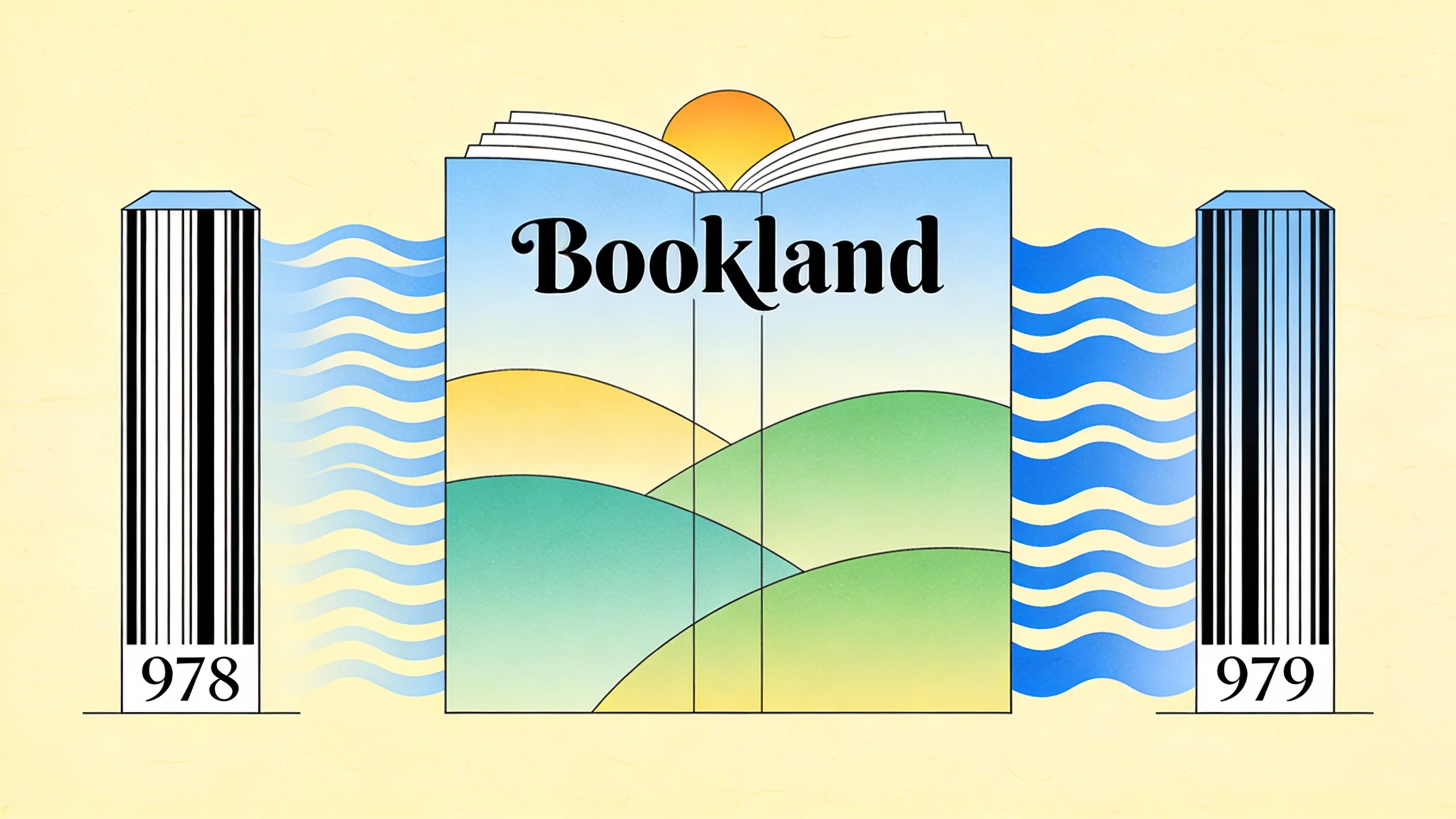
Have you ever heard of a country called Bookland? It sounds like a fantasy realm filled with libraries, but in the publishing world, it is a very real—albeit fictitious—place. It is the designated “country” for all books in the global barcode system.
For years, Bookland had a single area code: 978. But as the number of published books exploded, that code began to run out. Enter 979, the new prefix that is changing how ISBNs work. If you are an author or publisher, understanding the difference between these two prefixes is critical for your book’s distribution.
What is Bookland?
In the world of retail, every product has a barcode with a “country code” that tells systems where the product originated. For example, barcodes starting with 00-13 are from the US and Canada.
However, books are unique. They are traded globally and often printed in one country but sold in another. To solve this, the International ISBN Agency created Bookland, a fictitious country in the EAN (European Article Number) system.
By assigning the prefixes 978 and 979 to Bookland, books were given their own universal territory. This allows an ISBN to be turned into a worldwide compatible barcode (EAN-13) without needing a specific geographic country code. This clever hack is why you can sell your book in Japan, the UK, or the US using the exact same barcode.
Why 979 Was Introduced
For decades, the standard ISBN prefix was 978. It worked perfectly, allowing 10-digit ISBNs to be easily converted into 13-digit EAN barcodes by simply adding 978 to the front and recalculating the check digit.
However, the world writes a lot of books. With the explosion of self-publishing and digital formats, the pool of available 978 numbers began to dry up. To ensure we didn’t run out of ISBNs, the agency introduced the 979 prefix.
Think of it like a city getting a new area code. It doesn’t change how the phone works, but it does require everyone to update their address books.
The Big Difference: No 10-Digit Equivalent
Here is the most important technical detail for authors: 979 ISBNs do not have a 10-digit equivalent.
With the old 978 numbers, you could mathematically convert a 13-digit ISBN back to a 10-digit ISBN. They were interoperable.
- 13-digit: 978-0-123456-47-2
- 10-digit: 0-123456-47-9
With 979 numbers, this conversion is impossible. The mathematical algorithm that allowed the 10-digit system to exist simply cannot accommodate the 979 prefix.
- 979 ISBN: Always 13 digits. Never 10.
Why This Matters
This might sound like boring math, but it has real-world consequences. Some older computer systems in libraries, bookstores, and even shipping warehouses were built solely for 10-digit numbers. If you present them with a 979 ISBN, they literally cannot compute it.
While most modern retailers (including Amazon) have updated their systems, you may occasionally encounter a legacy distributor or a niche bookseller whose software “breaks” when trying to process a 979 code.
Key Takeaways for Authors
If you are assigned a 979 ISBN, don’t panic. It is a valid, official, and future-proof identifier. However, keep these tips in mind:
- Update Your Metadata: Ensure all your metadata fields only ask for a 13-digit ISBN. If a form requires a 10-digit number, leave it blank or contact support.
- Check Distribution: If you are using a smaller, specialized distributor, confirm they are “979 ready.”
- Use the Right Barcode: When generating your barcode, ensure your designer uses the full 13-digit sequence. You can learn more about this in our guide on ISBN vs Barcode differences.
Conclusion
The introduction of the 979 prefix is a sign of a healthy, growing publishing industry. “Bookland” is getting bigger! While the lack of a 10-digit conversion is a technical quirk, it is the new standard. Embracing the 13-digit format ensures your book is ready for the modern global market.

