
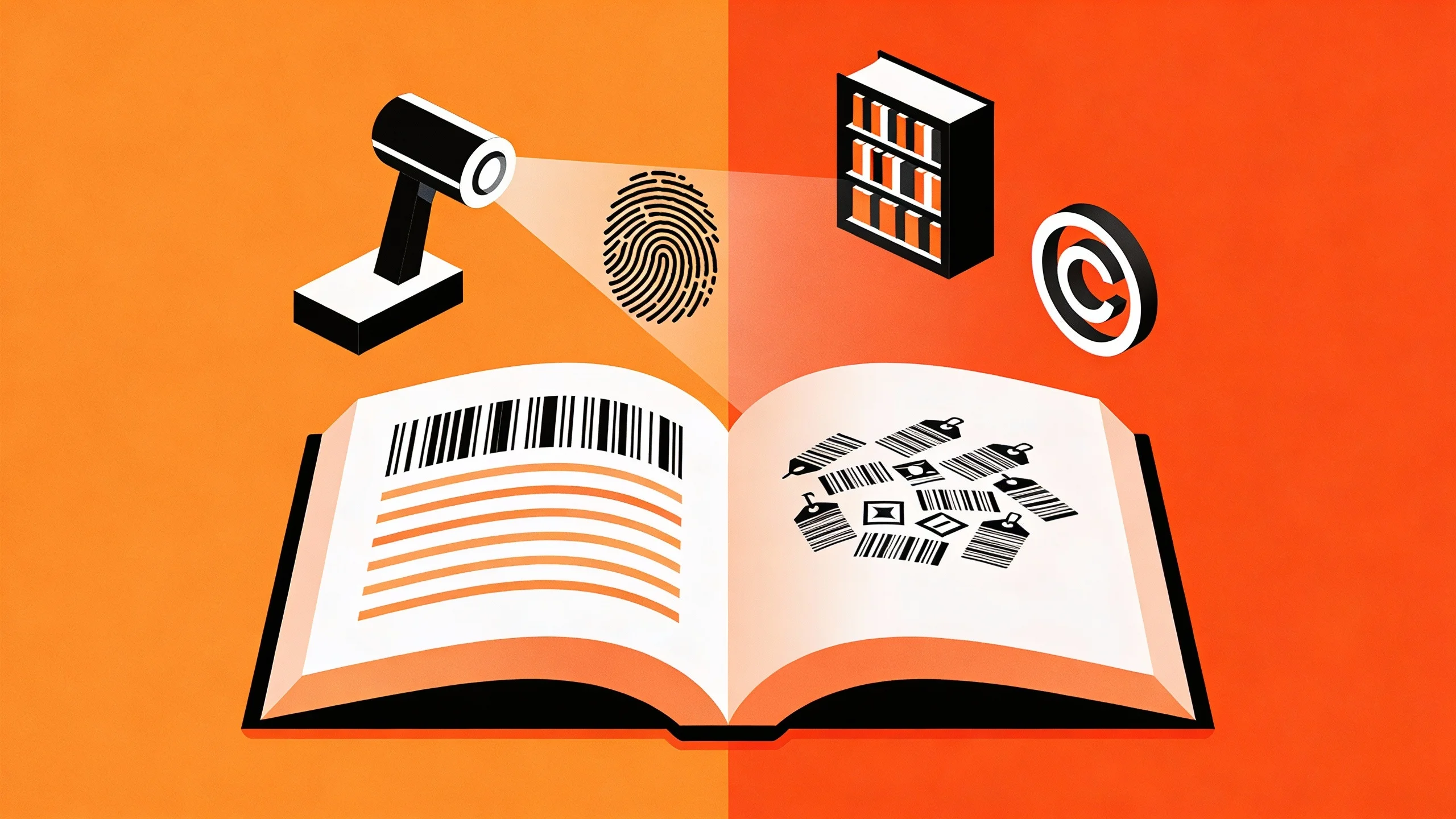
ISBN Number vs. Barcode: Understanding the Key Differences for Your Book
ISBNs and barcodes are often confused but serve different purposes. Learn the key differences and why your book needs both.
Many new authors incorrectly use the terms “ISBN” and “barcode” interchangeably. While they often appear together on the back of a book, they are two distinct elements with different functions. Understanding the difference is crucial for successfully publishing and selling your work.
Here is a breakdown of what sets them apart and why you likely need both.
What is an ISBN?
An International Standard Book Number (ISBN) is a unique 13-digit numeric identifier assigned to a specific edition of a book. Think of it as your book’s social security number or fingerprint. It distinguishes your title from every other book in the world.
Key characteristics of an ISBN:
- Global ID: It identifies the title, author, edition, and publisher.
- Metadata Link: It connects your book to essential data like price, page count, and description in global databases.
- Static Number: It is a string of numbers, not a graphic.
- Format Independent: You need a separate ISBN for hardcover, paperback, and ebook versions.
Publishers, retailers, and libraries use this number to order, list, and catalog your book. Without an ISBN, your book is invisible to the global book supply chain.
For more on how ISBNs protect and identify your work, read our guide on ISBN numbers and copyright.
What is a Barcode?
A barcode is a graphic image—specifically, a series of vertical black lines and white spaces—that machines can scan. On a book, the barcode is a visual representation of the ISBN.
Key characteristics of a barcode:
- Scannable Image: It allows scanners to read numbers quickly.
- Sales Tool: Its primary purpose is to facilitate transactions at the point of sale.
- Inventory Management: It helps retailers track stock levels automatically.
- Includes Price: Book barcodes (EAN-13) often encode the retail price in a smaller add-on barcode.
While the ISBN identifies the book, the barcode is the tool that makes selling that book in a physical store possible. When a cashier scans your book, they are scanning the barcode, which tells their system which ISBN matches that product.
Comparison Table: ISBN vs. Barcode
This table highlights the main differences between the identifier and the image.
| Feature | ISBN | Barcode |
|---|---|---|
| Format | 13-digit number (text) | Graphic image (lines) |
| Primary Function | Identification & Cataloging | Point-of-Sale & Inventory |
| Required For | Global distribution, listing | Physical retail sales |
| Source | ISBN Agencies (like Bowker or designated local agencies) | Generated from the ISBN |
| Human Readable? | Yes | No (machines only) |
Do You Need Both?
If you plan to sell physical copies of your book in retail stores, bookstores, or libraries, you absolutely need both.
- You need an ISBN to list your book in databases.
- You need a barcode so retailers can scan and sell it.
However, if you are publishing only an ebook, you technically do not need a barcode. Ebooks are digital files sold online, so there is no physical product to scan at a register. You still need an ISBN for proper identification, but the graphic barcode is unnecessary.
Important Note: You cannot have a legitimate book barcode without an ISBN. The barcode is generated from the ISBN. You must acquire your ISBN first.
Types of Barcodes for Books
The standard barcode for books is the Bookland EAN.
- EAN-13: This encodes your 13-digit ISBN.
- Price Extension (EAN-5): A smaller 5-digit barcode next to the main one that encodes the price is often required by major retailers.
If you are confused about where to get an ISBN, check our article on free vs. paid ISBNs to understand your options.
How to Get a Barcode
Once you have your ISBN, getting a barcode is simple. You do not need to register the barcode itself; you simply generate it.
- Self-Publishing Platforms: Sites like KDP or IngramSpark will often generate a barcode for you automatically when you upload your cover, if you leave a space for it.
- Third-Party Services: You can use Bookllo Publishing or other design services to create a high-resolution barcode file to place on your custom cover design.
- Generators: There are free online tools that can convert your ISBN into a scannable EAN-13 image.
Ensure your barcode is high resolution (300 DPI) and printed in 100% black on a white background for maximum scannability.
Conclusion
The ISBN is your book’s identity, while the barcode is the tool that allows it to be sold in stores. You generally need an ISBN first to create the barcode. By ensuring you have both correctly set up, you ensure your book is ready for professional distribution and sales.
Ready to secure your book’s identity? Visit our main page to get started with your ISBN.