

History of ISBN: From 10 to 13 Digits and Global Standards
Discover the evolution of the ISBN system from its 10-digit origins in 1967 to the modern 13-digit global standard that connects authors to readers worldwide.
The International Standard Book Number (ISBN) is more than just a barcode implementation on the back of a book; it is a global language that allows publishers, booksellers, and libraries to speak the same dialect. While we now take the 13-digit code for granted, the system began with a simpler 10-digit format in the United Kingdom and United States.
In 1967, the precursor to the modern ISBN was launched as a 10-digit format known as ISBN-10. At that time, because the system was primarily used in two major English-speaking markets, the categorization focused heavily on language-based registration groups rather than the strict national divisions we often see today.
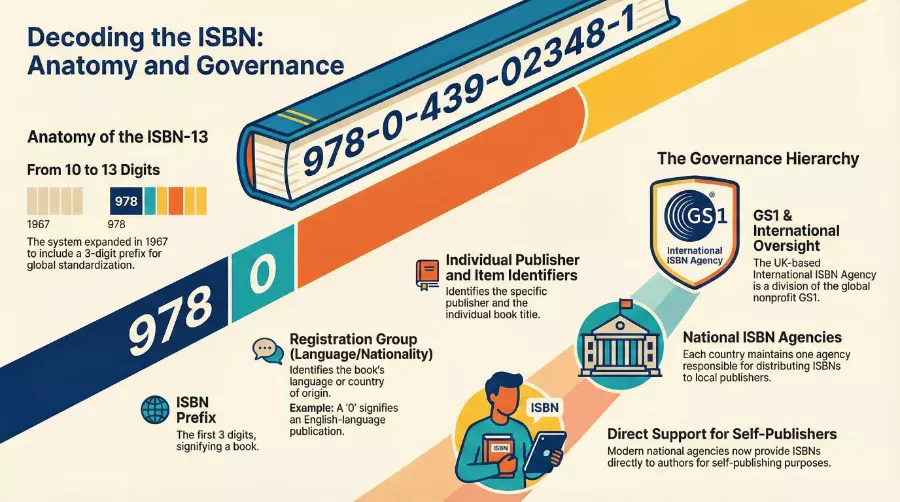
Evolution from ISBN-10 to ISBN-13
For decades, the publishing world operated on the 10-digit standard. However, as the number of published books exploded globally, the available numbers began to run out. To ensure the system could scale for the future, the International ISBN Agency expanded the format by adding a 3-digit prefix.
This change bridged the gap between the book world and the global retail supply chain. The new 13-digit format, called ISBN-13, made book identifiers compatible with the EAN-13 barcode system used for other retail products.
The structure of an ISBN-13 is precise. It begins with a prefix—typically 978 or 979—followed by the registration group, registrant, publication, and check digit.
Understanding the 5 Groups of ISBN-13
Every ISBN-13 is a string of numbers divided into five distinct parts, each providing specific information about the book’s origin.
For example, let’s look at the ISBN 978-0-439-02348-1. Here is how it breaks down:
- Prefix (978): The first three digits indicate that this is a book.
- Registration Group (0): This digit identifies the country, region, or language area. In this case, ‘0’ represents English-speaking countries.
- Registrant (439): This block identifies the specific publisher (e.g., Scholastic).
- Publication (02348): This number is assigned to the specific title or edition.
- Check Digit (1): The final number is used mathematically to validate the entire ISBN.
In the example above, the registration group 0 tells us immediately that the book belongs to an English-speaking market.
The Shift to National Registration Groups
As the ISBN system went global, the need for more granular definitions grew. While the initial groups were language-based (like 0 and 1 for English, 2 for French, 3 for German), the system largely shifted toward nationality-based registration groups to accommodate publishers worldwide.
Today, countries are assigned specific blocks (or “registration groups”) that allow for local administration. For instance, India manages the 81 and 93 groups, while Brazil manages 85. This structure allows for a decentralized but highly organized global network.
We have created an ISBN Agency Directory to help authors find agency information, including the specific registration group allocated to their country.
Who Controls the ISBN System?
The distribution and control of ISBNs follow a strict hierarchy to ensure no two books ever have the same number.
- Publishers & Authors: A book publisher (or self-publishing author) obtains an ISBN from their local agency.
- National ISBN Agencies: There is typically one designated ISBN agency per country responsible for assigning numbers to publishers in that territory.
- International ISBN Agency: All national agencies are coordinated by the International ISBN Agency, located in the United Kingdom.
The Role of GS1 and ISO
The International ISBN Agency operates within the broader framework of global standards. It works in close cooperation with GS1, a nonprofit organization responsible for standardizing business communication, most notably through barcodes like GTIN and UPC.
While the International ISBN Agency is a distinct entity and not a division of GS1, the two organizations collaborate to ensure the book industry aligns with global trade standards. GS1 provides the prefixes (978 and 979) that allow ISBNs to function seamlessly as EAN-13 barcodes at checkout counters worldwide.
The Rise of Self-Publishing
Historically, ISBNs were the domain of traditional publishing houses. However, the landscape has changed. With the rise of self-publishing, many national ISBN agencies have adapted their services to offer ISBNs directly to independent authors.
This accessibility empowers authors to own their publishing rights and metadata, ensuring their books can be discovered and sold on a global scale.